

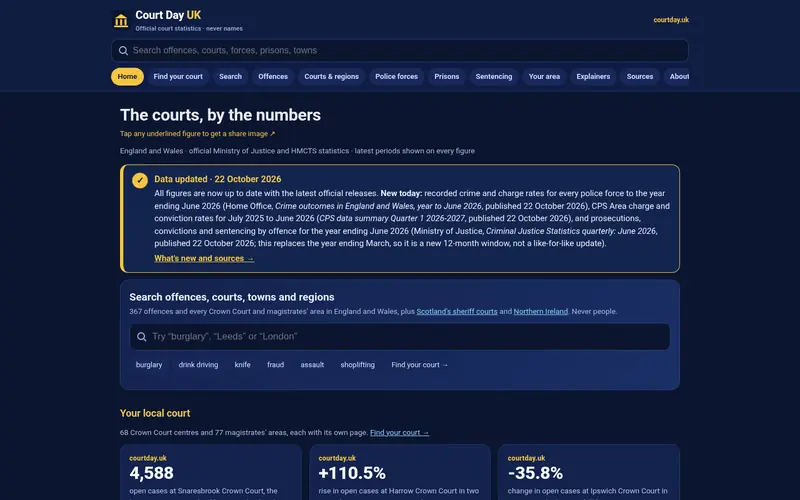
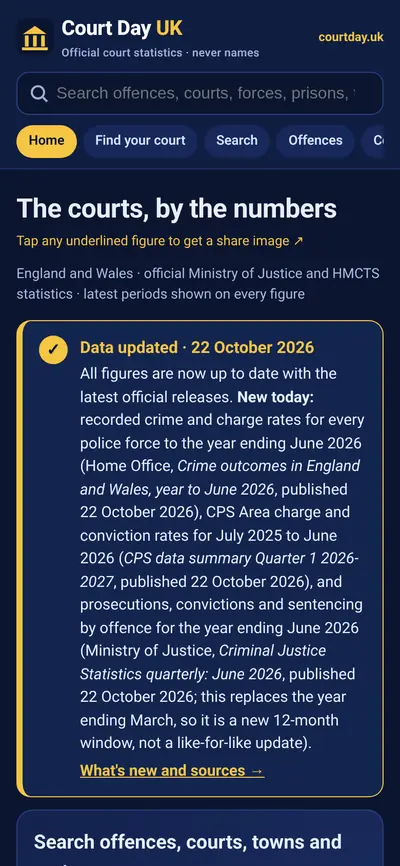
What it is
Court Day UK is a free, independent website that turns official court and justice statistics into pages anyone can read on a phone. It covers England and Wales, Scotland and Northern Ireland: 68 Crown Court centres, 77 magistrates' court areas, 39 Scottish sheriff courts and Northern Ireland as a whole, plus every police force and prison in England and Wales.
It follows the whole journey, from crimes recorded, to charge, to court, to sentencing, prison and reoffending.
The whole journey, in official figures
- Crime recorded
- Charge
- Court
- Sentencing
- Prison
- Reoffending
Courts covered
Who it's for
Anyone who wants to know how their local court is doing, and the people who report on it: newsrooms, data desks, legal press and justice charities. Every figure can be cited and shared.
What it does
- A page for every courtCaseloads, backlogs, waiting times and outcomes, with the official source under each figure.
- Site-wide searchFind any offence, court, town, region, police force or prison. It copes with typos.
- Postcode lookupFind your local court. The lookup runs in your browser, so your postcode never reaches the server.
- Tap to shareTap any figure for a ready-made share image with its source.
- Compare and league tablesSee how regions and courts stack up on backlogs and waiting times.
- Feeds and embedsAtom feeds for new figures and an embeddable backlog card for any court.
Why I built it
Everyone talks about the court backlog, but the numbers are buried in spreadsheets. I wanted to put the official figures for every court in plain view, on your phone, with the source under every number and no one's name anywhere.
The "no names" rule is deliberate. The site never collects, stores or shows any individual's name, case, court listing or criminal record, and nothing can be searched by person. Data about convictions is tightly controlled under UK GDPR and the Data Protection Act 2018, many convictions become spent under the Rehabilitation of Offenders Act 1974, and individual case details carry real legal risk. Aggregated official figures tell the story without any of that.
What the site shows, and what it never shows
Shown
- Aggregated official figures
- The source under every figure
- Courts, regions, police forces and prisons
Never shown
- Anyone's name
- Individual cases or court listings
- Criminal records
- Search by person
How it's built
A set of Python scripts downloads the official releases (Ministry of Justice, Home Office, data.police.uk, HMPPS, the Youth Justice Board, the Scottish Government, the Scottish Courts and Tribunals Service and the Northern Ireland Courts and Tribunals Service), aggregates them into a local database and builds every page as static HTML. Charts are drawn as SVG at build time, and each figure gets its own 1200×630 share image.
Before every upload a QA script checks for broken links and for anything that overflows a 390px phone screen. The data is refreshed every Monday, and the whole site is plain files on SiteGround, so it's fast and has very little to go wrong.
The data pipeline
Official releases
- Ministry of Justice
- Home Office
- data.police.uk
- HMPPS
- Youth Justice Board
- Scottish Government
- SCTS
- NICTS
Built for every court
- Static HTML pages
- SVG charts drawn at build time
- A 1200×630 share image per figure
- Atom feeds and embeds
- Refresh the dataNew official figures are pulled in.
- QA checksBroken links, and anything that overflows a 390px phone screen.
- UploadPlain files, so there's very little to go wrong.
Where it is now
Live and public since 15 October 2026, and updated as new official figures are published. The methodology page sets out the definitions, periods and limits behind the numbers.